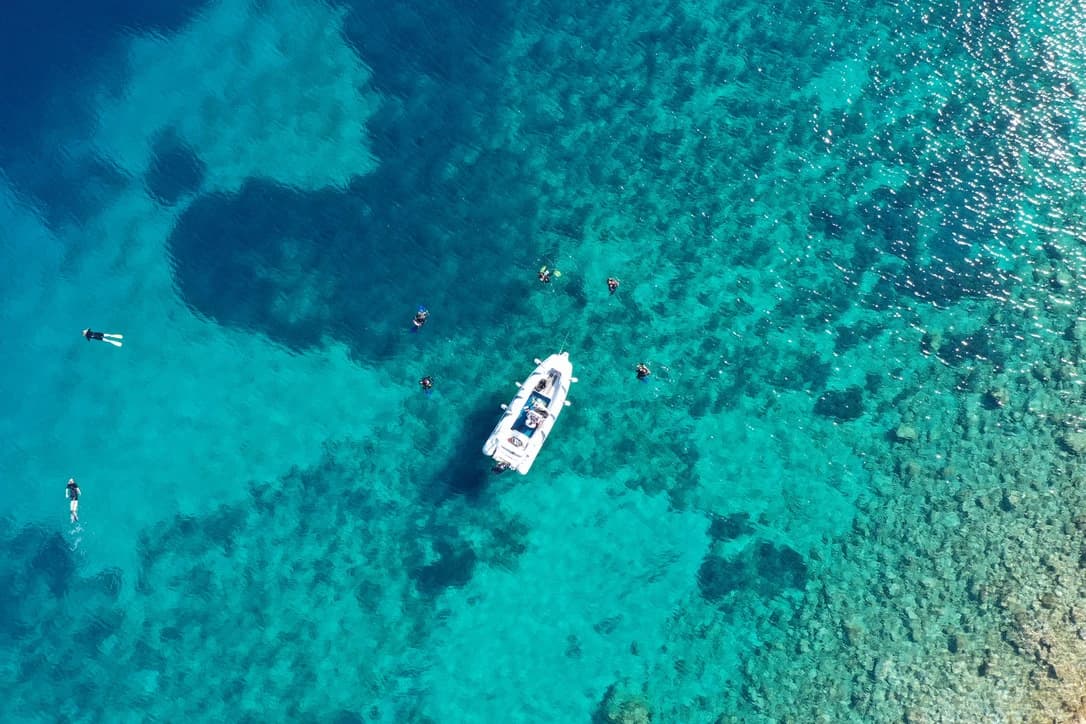
Amorgos and The Big Blue - The Island Behind the Cult Film
Amorgos, positioned between the Cyclades and the Dodecanese, became a global icon following the 1988 release of Luc Besson's "The Big Blue." Besson chose this island not just for its aesthetics, but for its extreme geological profile.
Amorgos is essentially a high mountain ridge that drops vertically into the sea. Just a few hundred meters from the shore, tectonic trenches reach depths of 700 meters.
These specific conditions allowed the director to capture the true scale of the abyss, making the island the perfect natural stage for the psychological and physical duel between man and the deep.
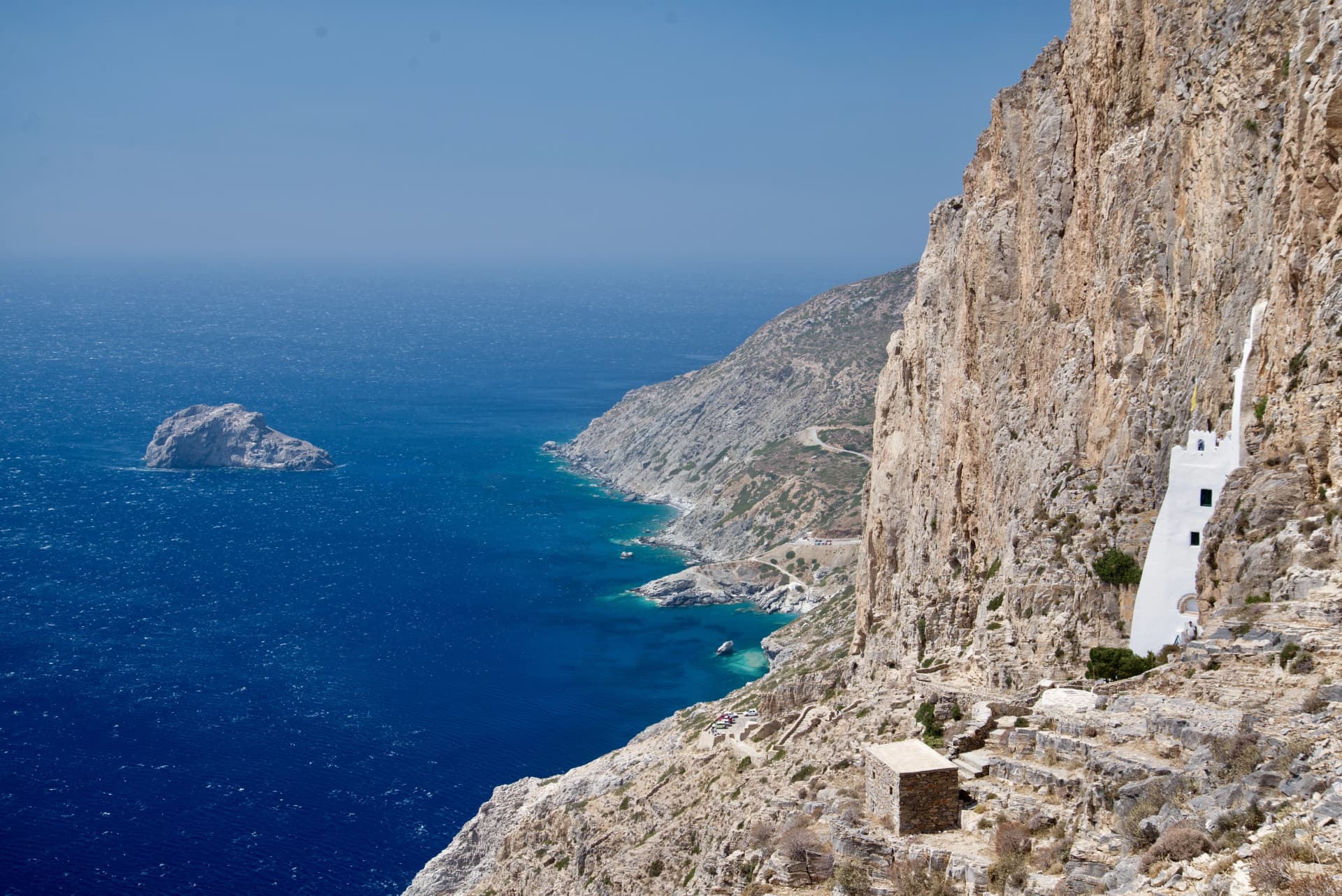 Amorgos cliffs and the deep blue sea
The Deep Blue Mystery
The legendary indigo color of the water is a result of marine physics. Most Greek islands have shallow, sandy bottoms that reflect light to create turquoise tones. Amorgos is different; it lacks a coastal plateau.
Because the seafloor drops so steeply, sunlight is absorbed by the depth rather than reflected back, leaving only the cobalt and violet spectrum visible.
Furthermore, the lack of plankton ensures underwater visibility often exceeds 40 meters. This clarity gives divers—and viewers—the eerie, beautiful sensation of flying through a silent, blue void.
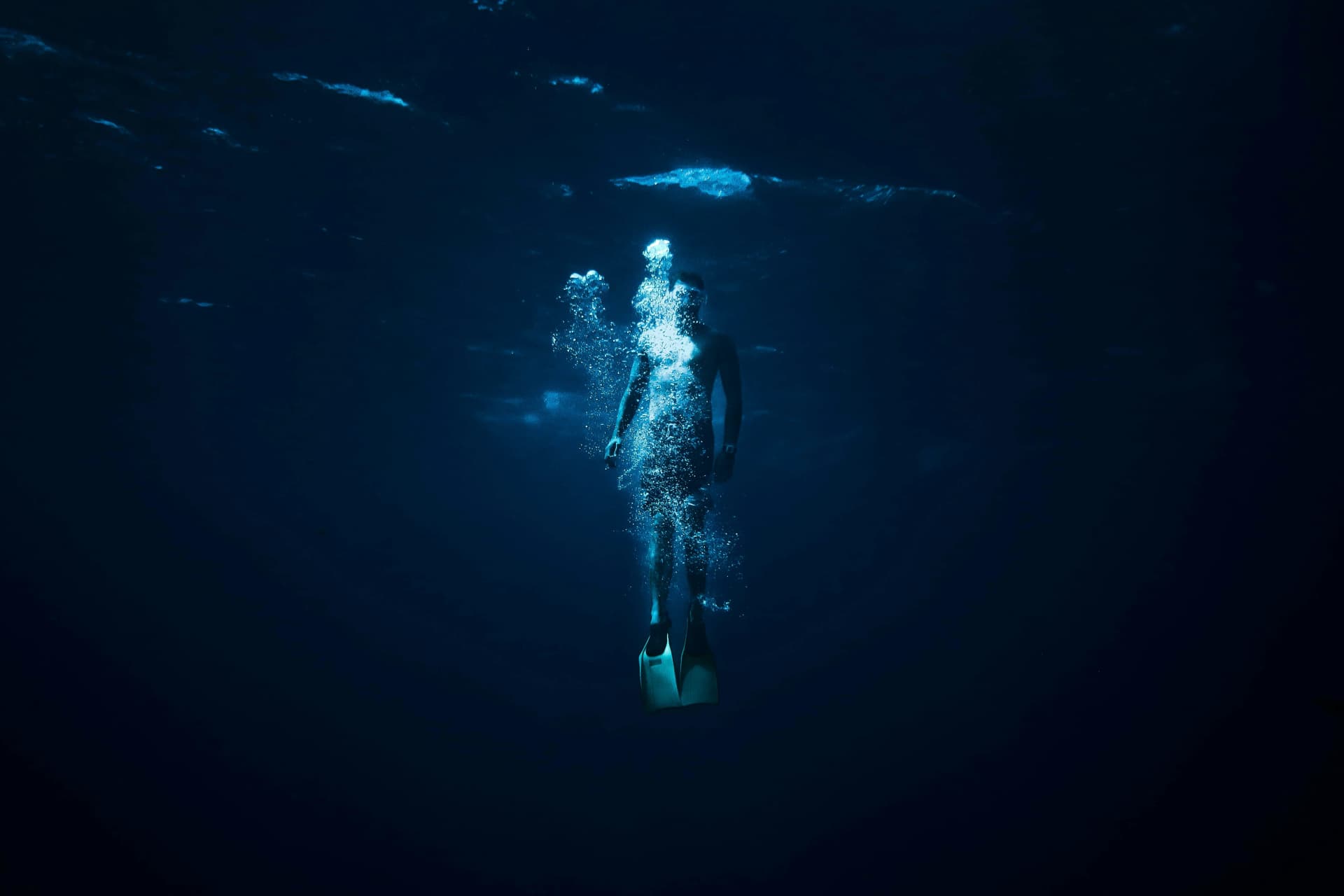 Underwater visibility and the cobalt color of Amorgos waters
Iconic Film Locations
The filming sites have become landmarks for cinema fans and divers alike. Agia Anna Bay, located directly below the white walls of the Monastery of Hozoviotissa, is where the childhood scenes of Jacques Mayol were filmed. The water here turns a dark, bruised blue almost immediately at the shoreline, creating a sharp contrast against the pale limestone.
Further south lies the Olympia shipwreck in Liveros Bay. The vessel has been wedged in the rocks since 1980. Besson used this rusted hull to frame the rescue scene with Enzo Molinari, highlighting the tension between the decaying metal and the purity of the surrounding sea.
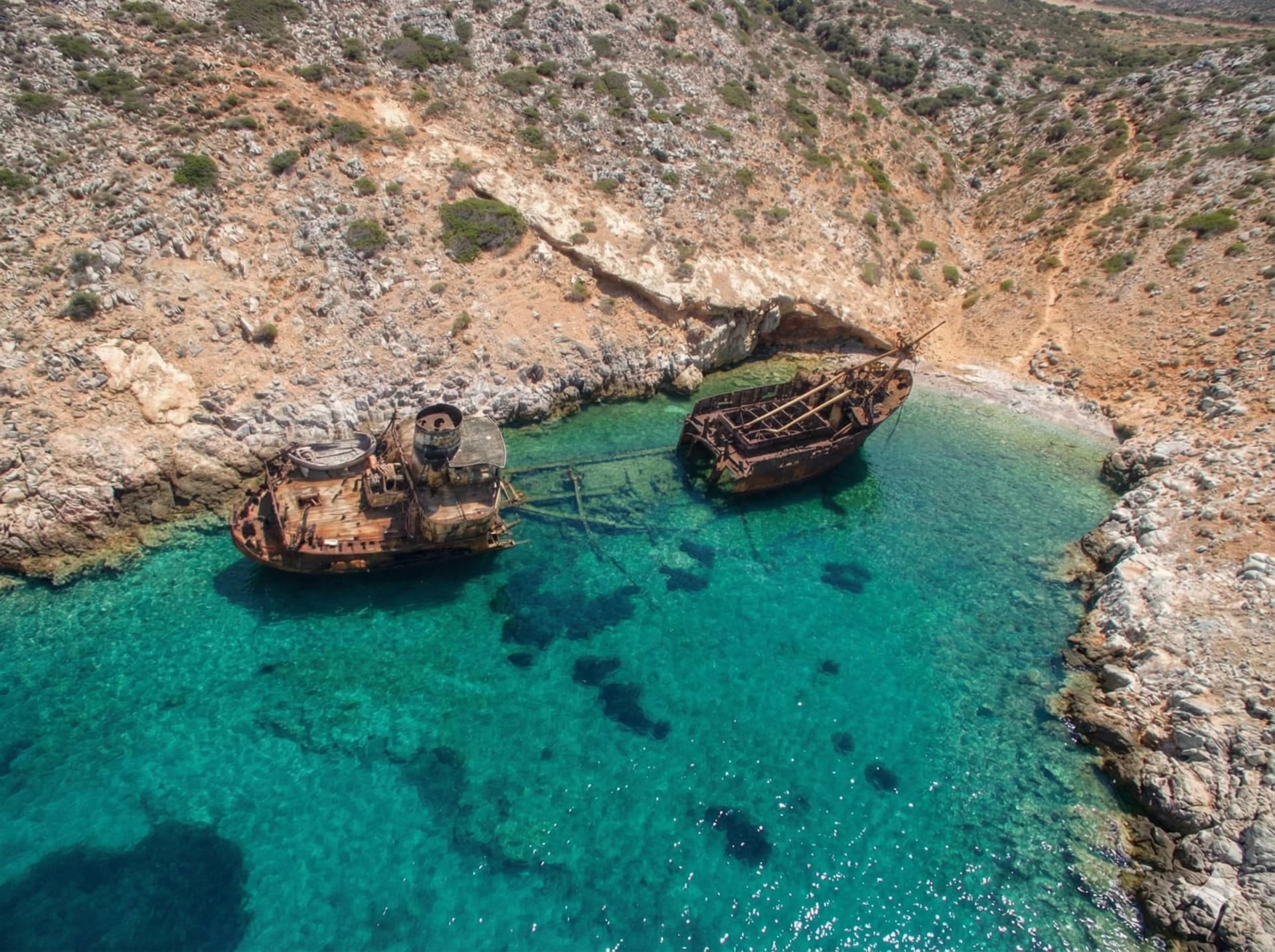 The Olympia shipwreck in Liveros Bay, a key film location
The Real Story Behind the Film
The movie is a fictionalized version of the rivalry between real-life champions Jacques Mayol and Enzo Maiorca. While the film portrays Enzo as a loud, hyper-competitive character, the two men actually shared a deep intellectual bond.
Mayol was a philosopher of the sea who used yoga and meditation to awaken what he called the "inner dolphin" in humans.
The film's ending also remains a point of history: the original European version ends with Jacques disappearing into the depths, while the US version was edited with a happy ending to satisfy test audiences who found the original too melancholic.
.webp&w=1920&q=75) Jacques Mayol and Enzo Maiorca in Sorrento, 1977
Jacques Mayol and Enzo Maiorca in Sorrento, 1977
The Legacy Today
More than thirty years later, the "Big Blue" spirit is still the main reason many travelers visit Amorgos. The island has avoided the massive development seen elsewhere, so the filming locations look nearly identical to how they appeared in 1988.
The monastery still clings to the cliffside 300 meters above the water, and the Olympia wreck continues to rust in the salt air.
For most visitors, standing on these shores is about more than just a movie; it is an attempt to find that specific brand of silence and freedom that Besson captured so well.
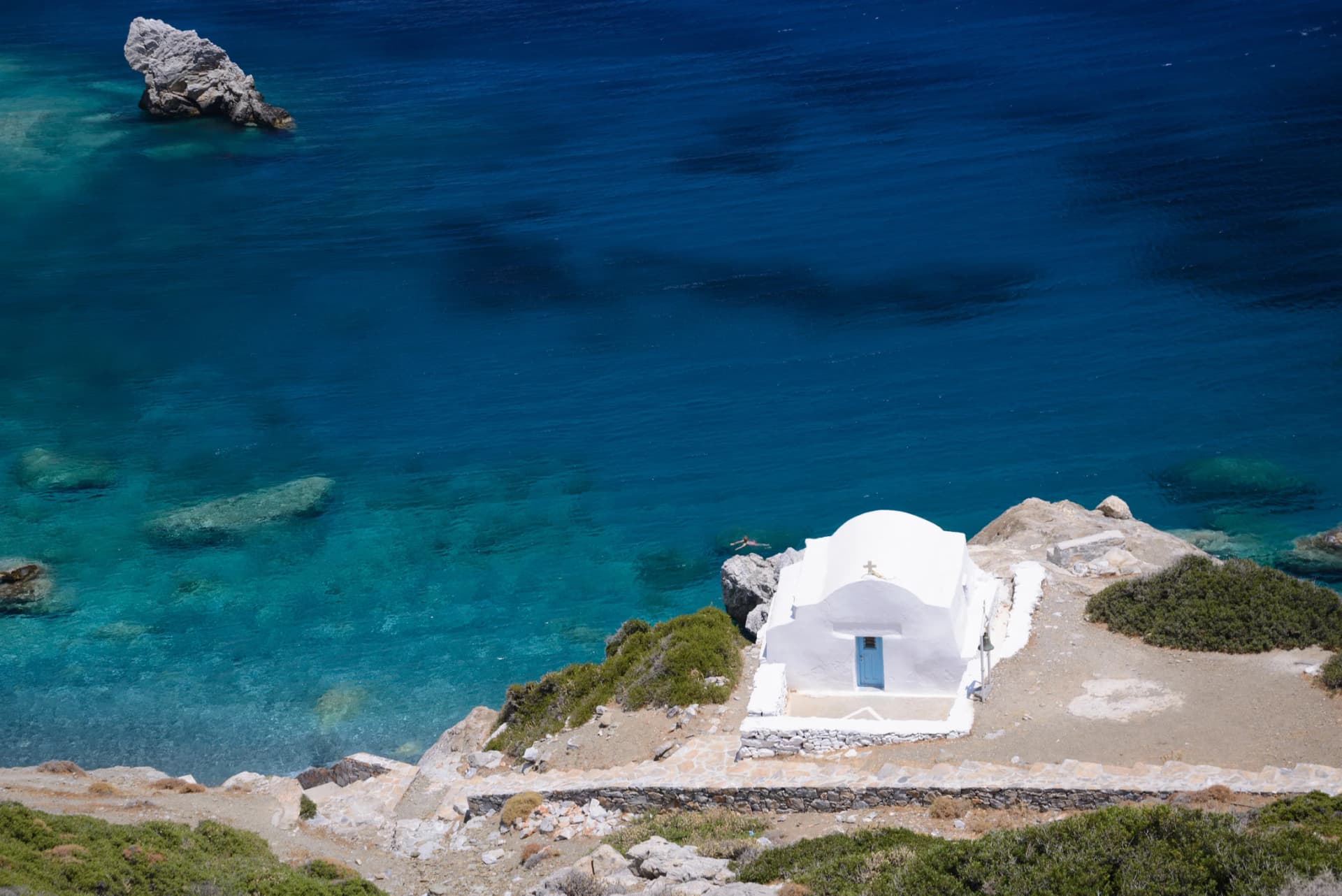 The small church of Agia Anna perched above the deep blue bay, famously featured in "The Big Blue"
Want to experience Amorgos like in the film? Our properties allow you to explore the same iconic locations from "The Big Blue."
If you want to experience the underwater world of Amorgos firsthand, we recommend Amorgos Diving—a local diving center that offers freediving courses and guided dives in the same crystal-clear waters that captivated Luc Besson.